Chapter I
The Stone Beside the Road
The road was familiar. The stone was not.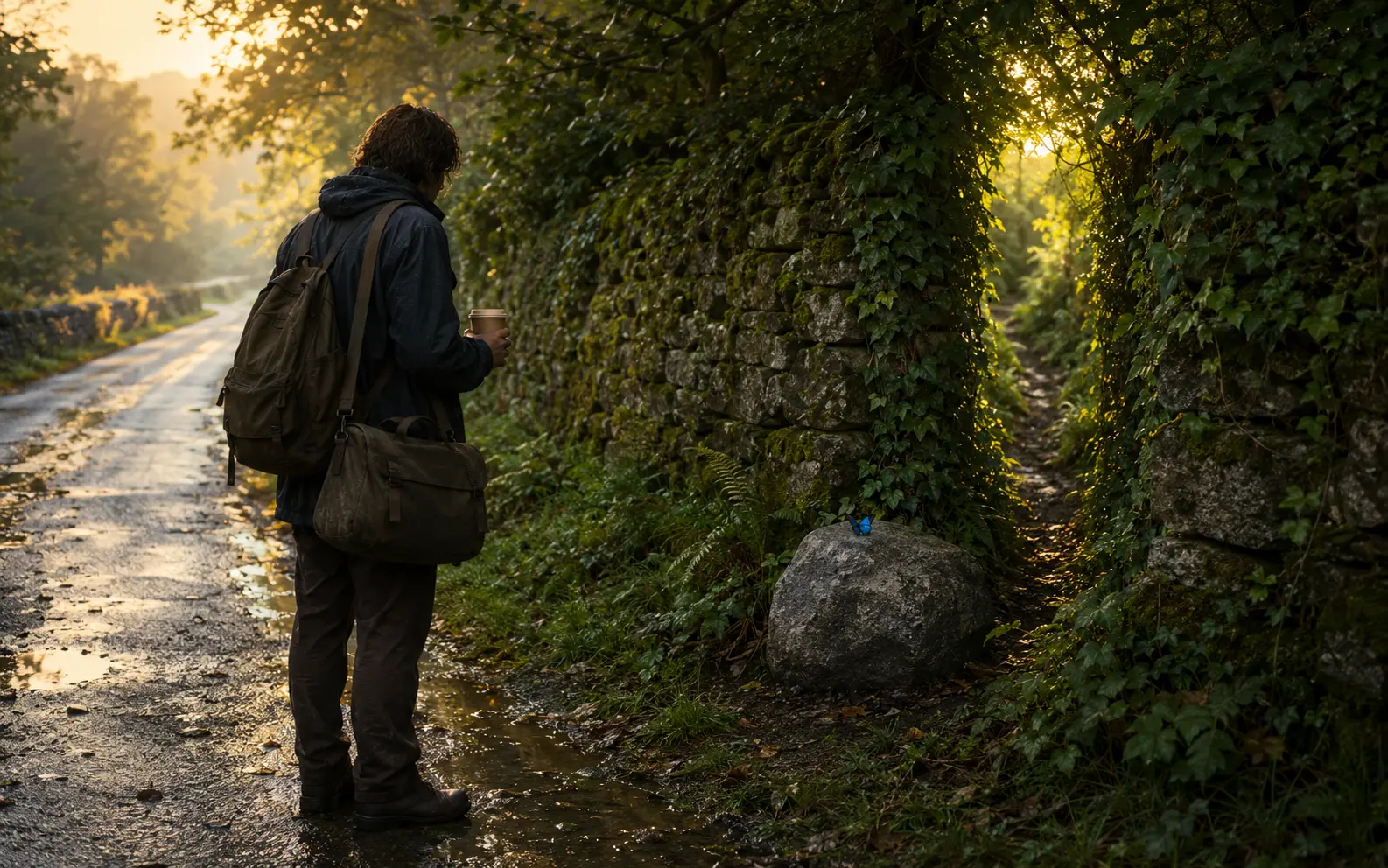
There are places that are built from stone.
There are places that are built from stories.
The Academy was built from something stranger still.
No one agrees on what that something was.
The old records are no help at all.
One says the Academy was found beneath a hill that had not been there the winter before. Another insists the Academy came first and the hill grew over it later.
A third record says there has never been a hill. It uses one hundred and six pages to prove this and includes several very rude drawings of the scholar who first suggested otherwise.
Gary believes this third record to be the most trustworthy.
Zora has never offered an opinion.
Kai once spent eleven nights comparing every account. He came out with forty-three possibilities, six likely mistakes in translation, and a headache he insisted was metaphorical. This meant it was not supposed to hurt, though it plainly did.
None of them explains the traveler.
Long before the traveler found the stone, Gary was awake beneath a bench.
This was not where the Academy had assigned him to be. The Academy had not assigned anyone to be anywhere in a very long time.
Most of its windows were dark. Ivy covered the west stair. A family of wrens had built a nest in the bell rope, and the bell had been considerate enough not to ring since spring.
In the empty rooms, dust lay untroubled across desks and maps. The fountains held their water as still as glass. Doors that once opened at a curious touch had forgotten what they were waiting for.
But that morning, one blue window high in the oldest tower had brightened for the first time in years.
Gary had seen it.
He had packed a clipboard, three pencils, half a biscuit, a spoon with no known duty, and Form 1-A: Arrival of a Person Who May Insist They Are Not Arriving.
Then he had hurried to the first bench and hidden underneath it.
He had been waiting there for two hours and fourteen minutes.
Gary did not mind. Important mysteries often arrived late. He had brought the other half of the biscuit for that possibility.
Far beyond the bench, the sleeping Academy gave one soft wooden creak, as if turning over in a dream.
Then, on the ordinary road outside, the traveler appeared.
The traveler was late.
The traveler had become unusually skilled at arriving exactly three minutes late—too little for disaster, too much for calm. Three minutes was enough to hurry through a doorway while taking off a coat, apologizing, and answering a message all at once.
The traveler often carried yesterday straight into today and called it being efficient.
On this morning, the traveler was also carrying a paper cup, two bags, a list of things not to forget, and an argument that had ended hours ago but continued making excellent points.
The list had been rewritten twice. The first version had lived on the back of an envelope. The second filled a clean page torn from a notebook and had three headings: urgent, important, and before anyone notices.
Several jobs belonged under all three headings. One had been underlined so hard that the paper was beginning to tear.
The traveler knew how to make a day obey a list.
Answer the message that might become a problem. Carry two things whenever one trip could be avoided. Put the difficult call between two easy ones, so there would be no time to talk oneself out of it.
Most importantly, do not sit down unless sitting can be defended as necessary.
This method had completed an impressive number of days. It had also produced the strange habit of waking tired from dreams about unfinished work.
The phone vibrated inside a coat pocket.
The traveler did not look at it immediately.
This restraint lasted nearly four seconds.
One message asked, Are you close?
Across town, two people waited beside a locked repair shed. The traveler had promised to bring the only working key before nine.
Another began, Sorry to bother you, but—
A third contained only a photograph of something broken and the confidence that the traveler would know what to do with it.
The traveler answered the first with Almost there, opened the photograph, enlarged the damaged corner, diagnosed the likely problem while walking, and nearly stepped into the permanent pothole.
The paper cup lost a small wave over its lid.
“Fine,” the traveler told the road, although the road had expressed no concern.
The argument resumed.
It had begun the night before at a kitchen table.
Someone the traveler loved had been sitting there with both hands around a cup that had gone cold. The room was quiet except for the refrigerator humming and the traveler gathering things for the morning.
“Stay,” the person had said.
The traveler had kept searching for a missing charger.
“I am staying.”
“No. Stay. Just stay long enough to hear me.”
The traveler had heard accusation instead of invitation.
“I cannot stop everything every time someone wants to talk.”
That was not a fair description of what had been asked. It was, however, a sentence sturdy enough to defend.
The person at the table had looked down into the cold cup.
“That is the problem,” they had said softly. “You think hearing me means stopping everything.”
The traveler had found the charger beneath a folded dish towel, which felt like proof of something at the time.
By the end, neither person could remember what the first quiet sentence had been trying to protect.
Now the traveler replayed the exchange for perhaps the twentieth time. Each new version ended with the traveler winning more clearly.
This was satisfying in exactly the way imaginary victories usually are—which is to say, not very.
The field to the right held the dull silver of a cold morning. Last season’s grass leaned beneath beads of water. Beyond the wall, bare branches worried at a colorless sky. Smoke from a distant chimney flattened in the wind and carried the smell of wet leaves and someone else’s breakfast.
The traveler noticed none of this.
Not until the stone.
The road was familiar.
The traveler had taken it in rain and sun, in good years and in the year no one mentioned. The wall on the left was familiar. The field on the right was familiar. Even the pothole near the bend seemed determined to remain forever.
The stone was not familiar.
It sat beside the wall where no stone had been yesterday.
It did not look ancient.
That was the first strange thing about it.
Truly ancient stones usually explain themselves. They wear moss, cracks, and soft edges. They look as if they have been waiting longer than anyone can remember and are in no hurry to answer questions.
This stone was gray, waist-high, and perfectly clean despite the mud around it. Its top leaned gently toward the road, almost like a head bent to listen. No weeds touched its base. No tire track, boot print, drag mark, or broken place in the wall explained how it had arrived.
Seeing while moving had become another skill.
The traveler passed it.
Seven steps later, a small voice in the traveler’s mind spoke up. It was the same voice that remembered forgotten passwords and worried about strange noises in the car.
There were words on that stone.
The traveler stopped.
The paper cup tilted. One bag slipped from a shoulder. A small object of uncertain purpose escaped, struck the road, and rolled beneath a hedge.
The object made a sound that suggested it was either expensive or the only one of its kind.
The traveler set down the cup, lowered one bag, and knelt beside the hedge. Wet twigs caught the coat sleeve. A thorn found the one strip of skin between glove and cuff.
The object had vanished. This immediately changed it from something of uncertain purpose into a thing without which the entire day might collapse.
For thirty irritated seconds, the traveler searched.
Fingers found a bottle cap, a smooth acorn, two coins fused by rust, and a brass key small enough to belong to a music box. None was the escaped object.
The key lay warm in the cold mud.
The traveler turned it over once, saw no reason for it to exist, and put it back beneath the hedge.
The missing object was eventually discovered caught in the fold of the bag where it had never actually fallen.
This did not improve the morning.
When the traveler stood, the stone remained where it had been.
From this angle, shallow cuts were visible across its face.
There are days when a person will walk away from wonder simply to stay on schedule.
This was nearly one of them.
Then a blue butterfly landed on the stone.
It was the wrong season for butterflies. The traveler knew little about them, but enough: the morning was too cold and windy for something so delicate to be doing business beside the road.
Its wings were not the bright blue of paint or cloth. They held the blue of distance—the color of mountains seen through weather, of evening gathering beyond the last lit window, of the narrow hour before darkness becomes complete. Fine black veins crossed them like paths on a map.
The traveler came closer.
The stone gave off the faint warmth of sunlit pavement, though the sun had not appeared all morning.
The butterfly closed its wings.
The carved marks vanished beneath them.
The butterfly opened its wings.
Five words were carved beneath it.
YOU HAVE BEEN HERE BEFORE.
The traveler had not seen those words before.
But something beneath them felt familiar.
For a moment the road disappeared, and the traveler remembered being nine years old beside a creek after summer rain.
There had been no schedule then. No messages. No one waiting for an answer.
Only a narrow opening between two boulders and the glorious possibility that it might lead somewhere no grown-up had bothered to name.
The child the traveler had been had crawled through without asking whether curiosity was productive.
Inside had been a pocket of blue stone, three sleeping beetles, and a bottle cap shining like buried treasure.
Nothing life-changing had happened there.
That had not made the discovery small.
The memory arrived so completely that the traveler could smell creek mud and warm pine needles beneath the cold roadside air.
Then it was gone.
“Yes,” the traveler said aloud. “That is how roads work.”
The butterfly appeared unimpressed.
The traveler looked behind, then ahead. No one was near enough to have arranged a prank. There were no cameras, no sign, no explanation, and—most suspiciously—no request to scan anything.
The bag on the traveler’s shoulder slipped again.
“I do not have time for this.”
The words were meant for the butterfly. Spoken aloud, they widened into the truth about many mornings.
The phone vibrated again.
Are you close?
The traveler looked along the road. Around the bend waited the next task, and then the next. Being needed by many people had one great advantage: it made quieter questions very hard to hear.
People depended on the traveler. Some had learned not to ask whether the traveler was tired because the answer would change nothing.
The butterfly remained on the stone.
“You are not helping.”
It closed its wings.
For one absurd moment, the traveler wondered whether the sentence had offended it.
The butterfly lifted from the stone and crossed the road. It did not fly away. It waited in the air near the familiar wall, where a curtain of ivy moved though the wind had gone still.
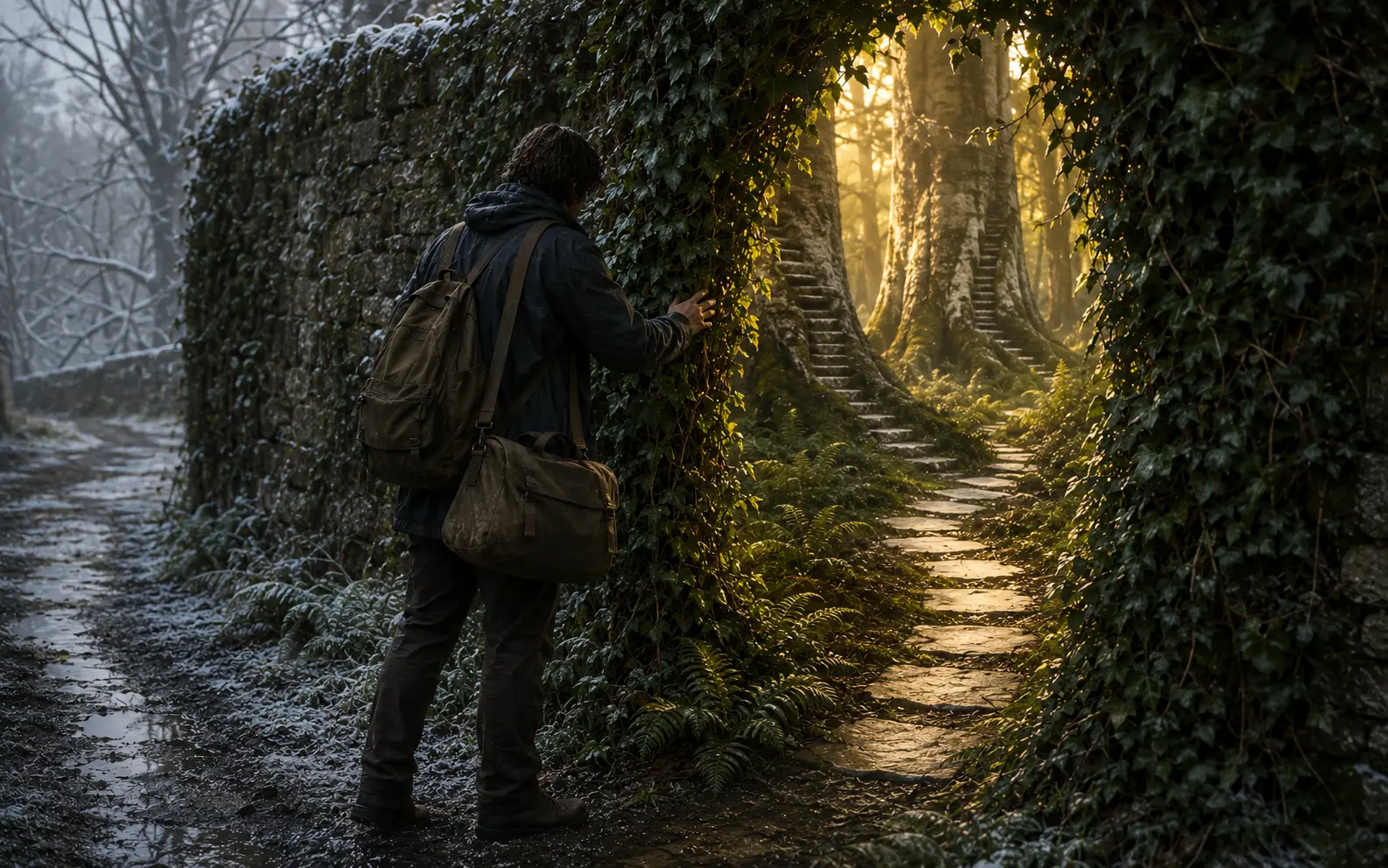
Behind the ivy was a path.
The traveler knew there could not be a path there. The wall bordered an ordinary field. Beyond the field stood an ordinary row of trees. Beyond those trees was a small pond, which a nearby sign rather hopefully called a lake.
The opening was narrow enough to dismiss as a trick of light.
The traveler crossed the road.
The ivy smelled green despite the cold. Its leaves lay over one another in thick, dark layers. Their stems grew from cracks far too small to hold enough soil.
The wall behind the ivy was exactly where it should have been—except for the place where it was not.
Through the opening, pale stepping stones curved beneath trees.
Not the ordinary trees beyond the field.
These trunks were wide enough to contain staircases. Their bark folded in long silver ridges. Ferns remained green beneath them though frost whitened the roadside grass two paces away.
The traveler put one hand through the ivy.
Warm air moved across the fingers.
The hand was withdrawn.
Cold wind touched it again.
The traveler checked the wall from the left. Stone.
From the right. Stone.
From directly in front: a path that had no room to exist, and yet did.
The traveler tried the warm air once more. Fingers through the ivy: summer. Fingers back beside the road: winter.
A bird called from somewhere beyond the opening. The note was low and round, like a drop of water falling into a deep bowl.
“No,” the traveler said.
This was a complete and reasonable answer.
The butterfly entered the ivy and disappeared.
The traveler checked the time, the road, and the list. None offered a category for impossible paths.
The phone offered two missed calls, four messages, a weather warning for a place the traveler was not, and a map showing an unbroken wall.
The traveler typed Delayed. Something unexpected.
The message was deleted.
Be there soon.
That message was sent.
The traveler lifted both bags and the paper cup. One strap caught on the ivy. The cup lid pressed loose and released the smell of coffee already cooling past enjoyment.
One step into the opening would be enough to see how the trick worked.
One step was not a commitment.
The traveler had used this reasoning before in several situations that became commitments.
Then, for reasons that would later be called fate, tiredness, curiosity, poor judgment, perfect timing, and a small rebellion against calendars, the traveler stepped through the ivy.
The path smelled of rain.
Not rain falling. Rain remembered.
It curved between trees too old to have fit inside the field. Light gathered in their branches without any visible source. Small bells sounded far away, although there was no wind and no tower.
The farther the traveler walked, the less the path behaved like a path and the more it behaved like a question.
A round green door appeared low in the trunk of an oak. It was no higher than the traveler’s knee. A brass knocker shaped like a sleeping fox hung at its center.
When the traveler bent to look, the fox opened one painted eye.
“Appointment?” it whispered.
“No.”
“Excellent,” said the fox, and went back to sleep.
The door would not open. The traveler was surprised to discover this was delightful.
The first step sank slightly into moss.
The second landed on stone worn shallow at its center.
By the third step, the noise of the road had changed. Engines still passed beyond the ivy, but now they sounded very far away, like traffic heard from beneath a warm blanket.
The phone still showed a signal. Its clock still moved forward. The traveler checked both twice and trusted neither.
There were signs that others had used the path.
A low branch had been polished by hands. Blue thread looped one exposed root. A shallow footprint held clear water although no rain had fallen. Beside it was the smaller print of an animal with four round toes and no visible concern about mud.
A stream crossed the path a little farther on.
The water ran uphill.
Silver minnows floated backward in the current, looking bored by the arrangement. When the traveler touched the surface, one drop climbed the finger, paused at the knuckle, and fell upward into the leaves.
The traveler laughed once in surprise.
The sound seemed to startle the forest.
Tiny golden lights woke beneath three ferns. Somewhere ahead, a shutter opened. The distant bells answered one another—not in alarm, but like rooms passing a secret from one to the next.
The traveler turned back. Through the opening, the paper-gray road and stone wall remained visible. Even the pale ring left by the forgotten cup waited on the wet pavement. The way out had not vanished; it simply seemed less inviting.
This mattered.
If the path had trapped the traveler, staying would not have been a choice.
Instead, the road waited.
The traveler chose another step.
The trees received it without celebration.
Light moved high in the branches. Not sunlight. Something softer, traveling from leaf to leaf as if the canopy were remembering dawn. The air carried wet cedar, cold stone, crushed mint, and a trace of woodsmoke from no visible fire.
The traveler had forgotten that a smell could be noticed before it had to be checked for danger, smoke, damp, or something else needing repair.
A bell sounded once to the left.
Another answered much farther ahead.
For one breath, the trees opened.
Across a valley that could not possibly fit behind the roadside wall, the traveler saw rooftops catching gold light. Narrow towers rose between them. Bridges crossed open air. Waterfalls spilled from a garden high above the clouds and vanished into mist before reaching the ground.
At the center stood a great dark building with hundreds of windows.
One window was blue.
As the traveler watched, another window warmed to amber.

Then the branches closed, and there was only the path again.
Beneath both bells came the ordinary, uneven sound of breathing. It took a moment to recognize it as the traveler’s own.
One bag was shifted to the other shoulder.
The unfinished argument tried again. Its sentences entered the path, found no audience, and lost their shape.
The traveler took one step.
The ivy closed behind.
This should have caused alarm.
It did not seal like a gate.
The ivy gathered like a curtain after someone passes through. Soon the opening looked like ordinary leaves. The road could still be heard, and cold daylight appeared whenever the traveler parted them.
The restored wall made the body turn cold. Then something far more dangerous arrived.
Relief.
Not happiness or safety. Relief like the silence after a loud machine stops, when only then do you discover how long it had been roaring.
It came without a receipt. The list was unfinished, the argument unresolved, and two people waited beside a locked shed.
Yet the jaw unclenched.
The hand holding the phone lowered.
For the length of three breaths, no one needed anything.
The traveler nearly cried.
This was so inconvenient that the traveler immediately adjusted both bags and began walking again.
The path bent around the first enormous tree.
Its roots lifted a small circle of ground like the rim of a shallow bowl. Within that shelter stood an old wooden bench. The boards had silvered with weather, but the seat was dry. Initials, circles, short lines, and one badly carved fish marked the back rail. Someone had mended a split in the left arm with three careful bands of copper.
The bench offered no sparkle, song, or floating arrow. Nothing about it demanded attention.
That was perhaps why the lantern could be seen.
On it sat a lantern.
It was old, dark, and entirely unlit.
The traveler waited for it to flare into life, because mysterious lanterns in impossible forests are usually expected to do something of that sort.
It did not.
A faint blue reflection moved across its curved glass.
The traveler looked up for the butterfly.
Only branches held the light.
The lantern had no dust on it. No wet leaves gathered beneath its base. The wood around it had turned pale from years of weather, yet there was no dark mark where the lantern sat.
It looked as though it had rested there forever and had been placed there only a moment ago.
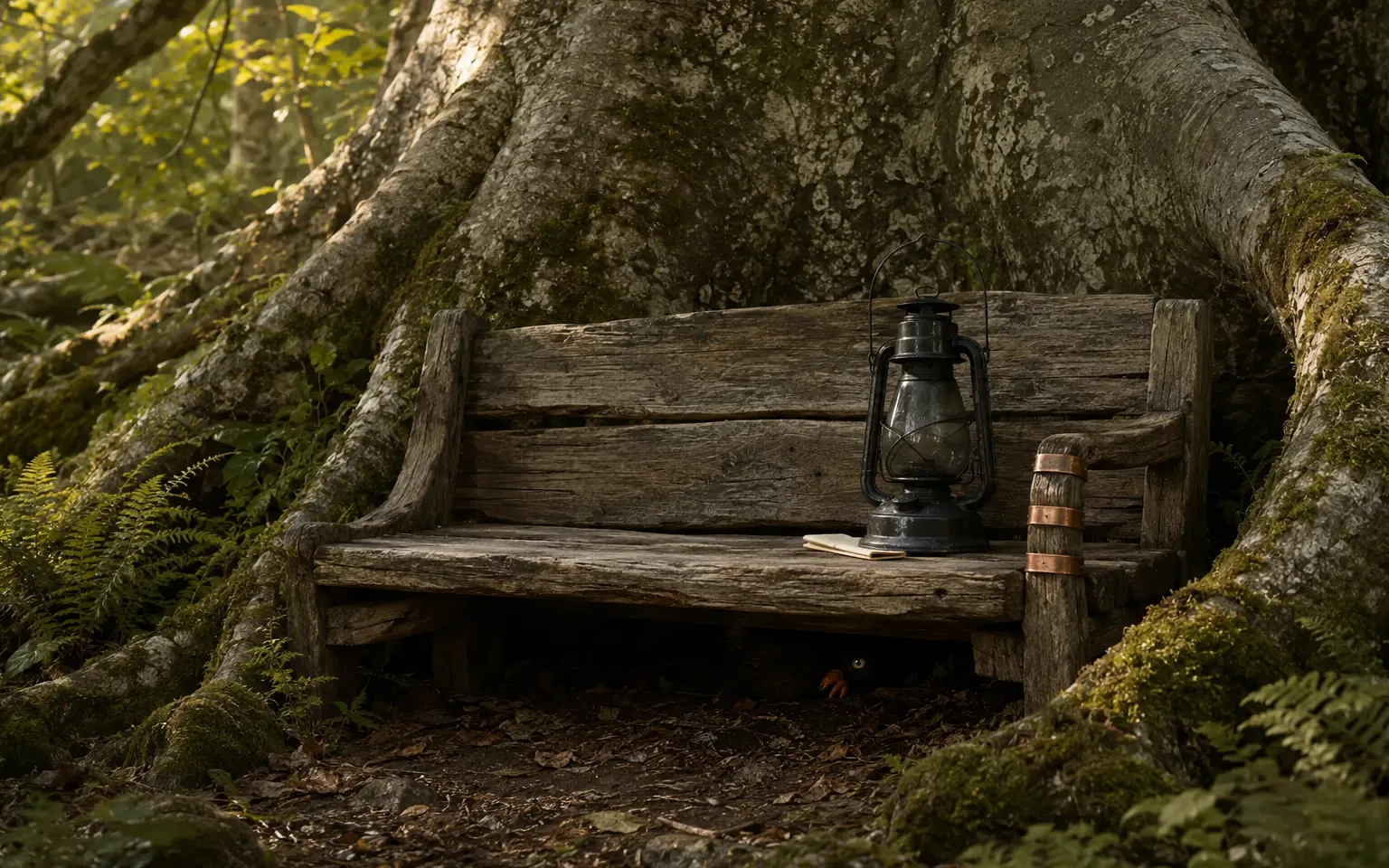
A narrow piece of paper had been tucked beneath its handle.
The traveler unfolded it.
There were no instructions.
Only one sentence:
The lantern you seek is already within.
The traveler read it twice. The calm handwriting made it seem more presumptuous.
“Wonderful,” the traveler said. “Riddles.”
From somewhere beneath the bench came a small, delighted sound.
It might have been laughter.
It might have been claws against wood.
The traveler looked toward the ivy.
The road was still there, though it could no longer be seen without searching.
The list inside the bag remained unfinished.
The phone vibrated once and stopped.
Beneath the bench, something tried and failed to suppress another laugh.
It might have been the beginning of the Academy waking up.